

Clinical care alone can’t address health challenges like loneliness & mental health.

People struggle more at work & in their daily life when they don’t have social connections.

Loneliness is increasing across all age groups, but older adults are particularly affected.

1 in 5 GP appointments are for non-medical problems: Social activities could reduce GP visits by up to 2.5-3% each year (2.8-3 million appointments).

Signposting services can help to blend health, social & community organisations working together.

Taking part in social & cultural activities can make life better than healthcare by itself.
Social isolation & loneliness
Loneliness hurts – both people & communities. Social isolation & the loneliness it causes can reduce quality of life, affect physical & mental well-being & financial security.
Adult social isolation ranges from 15 – 40%
More than 1/3 of adults over 45 are socially isolated
Nearly 1/4 of adults over 65 are socially isolated

Mental health risks
Poor mental health (e.g. depression/anxiety) is common in people experiencing social isolation.
Feeling lonely can make mental health worse.
Loneliness increases risks of developing anxiety & can lead to social anxiety.
For depressed or anxious people, their symptoms can be worse if they have less social connections or a weak support network.
Social & economic health risks
Loneliness impacts people, workplaces & communities, reducing productivity & well-being. It also leads to higher healthcare costs & poorer job performance.
Social & economic health risks
Poor social connections are linked to worse physical health, longer hospital stays & risk of early death.
Older adults who are socially isolated or lonely have:
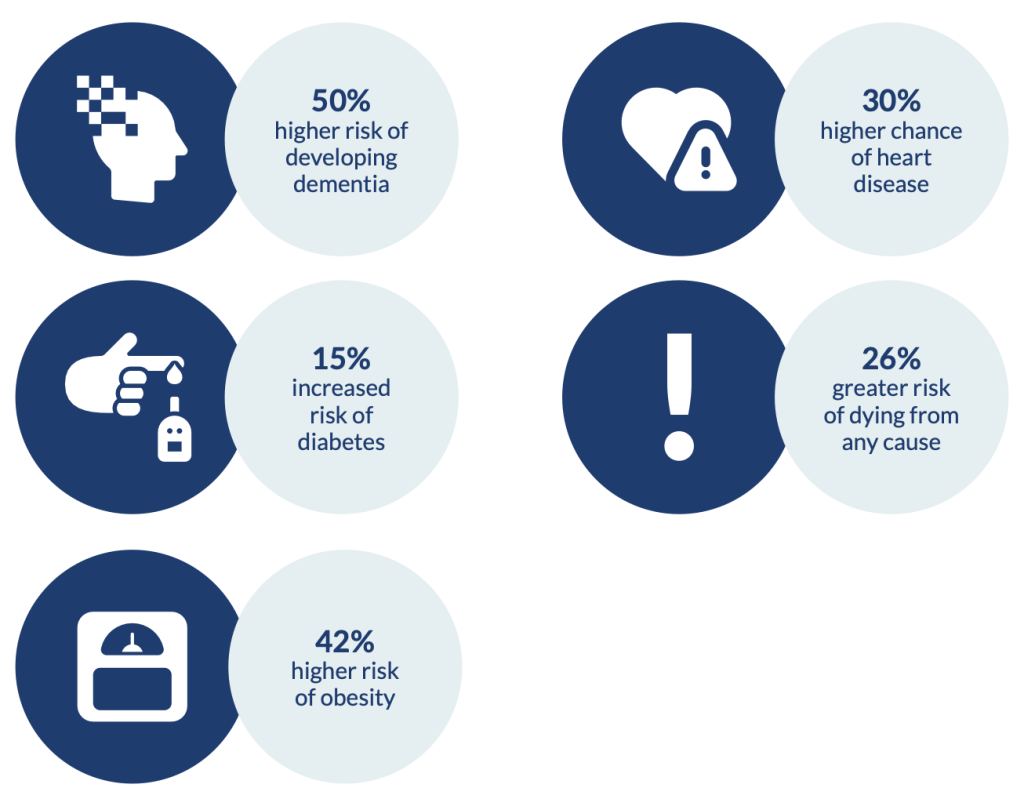

Loneliness is as harmful as smoking 15 cigarettes a day.
Social isolation is linked to higher suicide risks, especially in older adults with less social interactions.

People without social connections have weaker immune systems & are more vulnerable to infections.

Health inequalities
Disadvantaged people are more likely to experience mental health problems due to the health inequalities (structural differences in living circumstances) they face & they are less likely to access services to get help.
Services based in communities offer a way to help with this issue.