
Pressures on health & social care services
The NHS is under pressure to meet patient needs with limited resources & staff.
The 2025 NHS 10 Year Health Plan’s key reform objectives aim to reduce pressure & help sustain the NHS by:



How can we reduce this pressure?
There is a growing shift towards person-centred care. This type of support focuses beyond clinical treatment & on social connections, community support & non-clinical care.
When there is collaboration between healthcare, voluntary, community, faith & social enterprise (VCFSE) sector organisations, it helps to reduce impacts from social determinants of health.
These collaborations can potentially improve health & care outcomes for communities.
Community signposting services can help in the following way:

“we get a lot of referrals who are completely not suitable. […] We’ve had referrals from the likes of Adult Social Care who, without sounding rude, just need to tick a box and need to tick that they’ve done something for this person. So people who have complex needs, which we are not equipped to deal with at all.”
Staff member
The Connected Communities research project
This research project was about community signposting services that use people known as signposters.
Signposters link people up with different kinds of help & activities in the community where they live.

A team of researchers from the University of Lancashire looked to see if community signposting services are set-up & run in a helpful way to people who work with the service & people who use the service to find local support in their community.
This research was funded by the National Institute for Health and Care Research (NIHR) as part of the Applied Research Collaboration (ARC) National Priorities Programme for Adult Social Care & Social Work.


Why have we done this research?
The team wanted to find out how people feel about using or working with community signposting services & understand how these services can work best.
From this research, the team made suggested strategies for how these services can be set-up & keep going.
The information in this toolkit will help other people sustain similar services in different communities.
Who did we do this research with?
The research team worked with three existing community signposting services as case studies. These services were identified from NIHR ARC NWC members.
They are representative of a local group of community signposting services & they work at different intensities (referral volumes & staff).
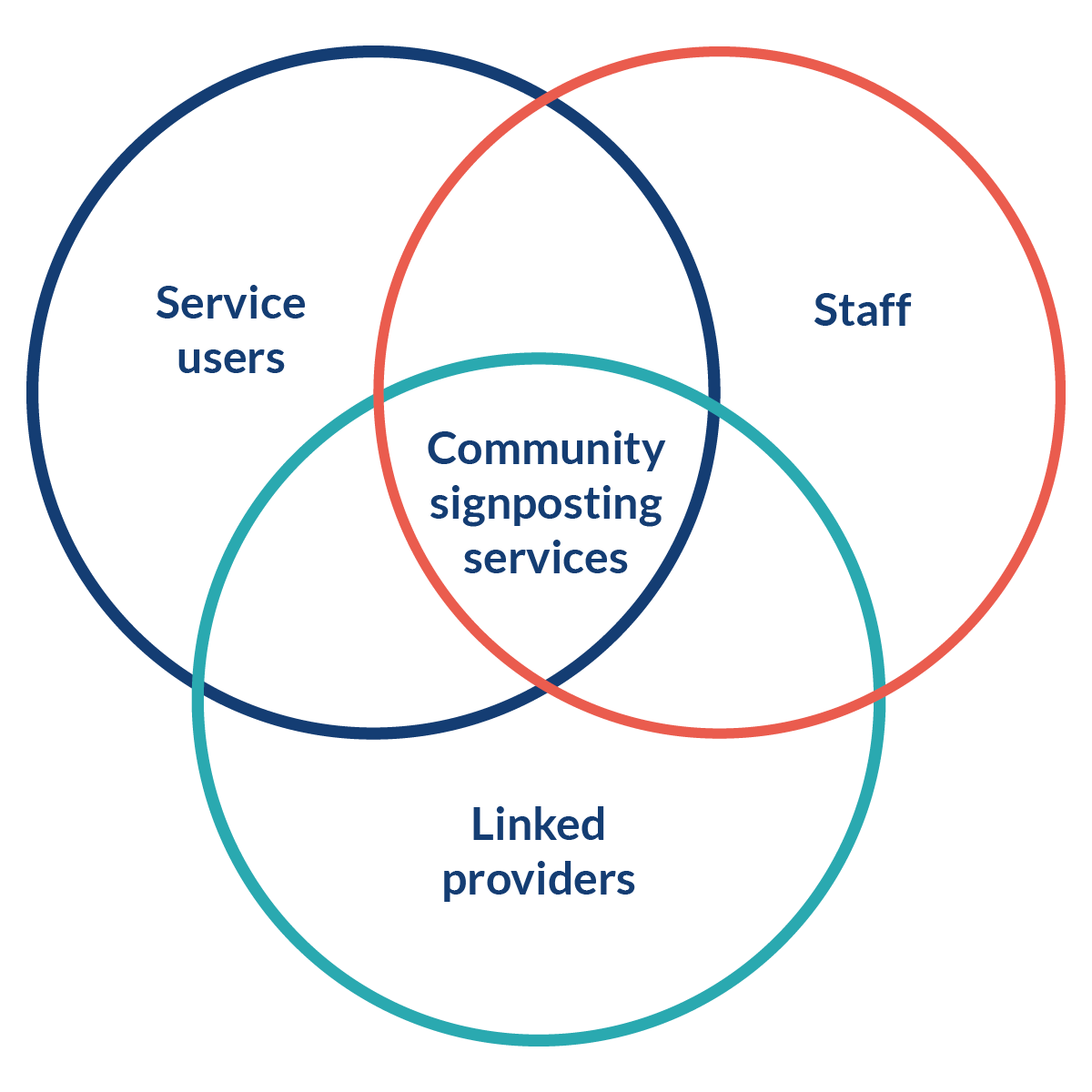
The team spoke with service users, staff (including signposters) & linked providers (people who refer service users in & out of the service).